

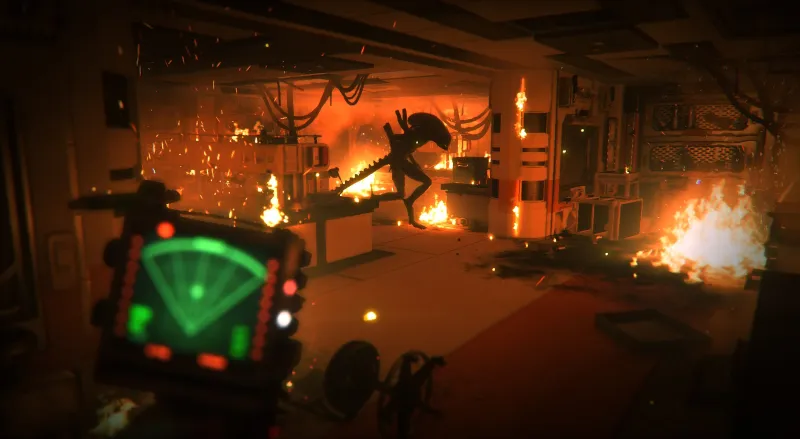
In 2014, game developer Creative Assembly made gamers scream, cower, and hide behind the sofa with survival horror Alien: Isolation. Set 15 years after Ridley Scott’s 1979 film, Alien, Isolation follows Ellen Ripley’s daughter, Amanda, on a quest to discover what happened to her mother while reckoning with the same perfectly evolved organism in the process. The game’s complex enmeshing of interactive and unscripted AI, sound, and programming systems, combined with its renown for breathing new life into the survival horror genre through its first-person perspective sees Alien: Isolation regularly cited as the greatest Alien game of all time. So how did a game developer known for ports and real-time strategy games create one of the most notable modern survival horrors? It all began with one man and a movie novelization.
Game director Alistair Hope originally made games with secondary school friends, a few of which nearly came close to being published. He began at Creative Assembly in 1996, registering as the eighth employed person at the company and beginning as a trainee artist on an Australian NFL game, which he says taught him the importance of understanding the audience you are making your game for. His first introduction to Alien was actually through Alan Dean Foster’s novelization before seeing the movie, which he read cover-to-cover over and over again. Once he finally saw the film, the poster for the iconic 1979 horror was plastered above his bed, with the Jerry Goldsmith soundtrack regularly playing on repeat throughout his house. To Hope, he’s always understood the idea of Alien as ‘Ridley Scott’s haunted house in space’ and had wondered for a long time why people hadn’t tapped into that idea more. Around 2008, the Creative Assembly console team had just delivered Viking: Battle for Asgard and were spit-balling ideas for its next project. “I knew that Sega had the license to make Alien games, and this team needed something to do — so why don’t we make an Alien game?”
Many Alien games pivoted around you playing either as the Xenomorph or as a decked-out Colonial Marine with an infinite arsenal of bullets. “The dream was simple — we wanted to deliver the experience of what it would be like to encounter Ridley Scott’s original alien, in a lo-fi setting where it was clear you weren’t the predator,” Hope says. “You were the prey. No one had made that experience yet, and I just felt that idea was really special.”
While the rest of Hope’s team moved on to the next Total War game, he delivered a five-slide pitch deck outlining Alien: Isolation to the studio head, who then approved a small team to create a mood video expanding on Hope’s vision. The team was able to recreate the sci-fi horror’s lo-fi medical lab, complete with Facehuggers, out of an engine designed for a Viking-era world with the singular light source of the sun. “It was the worst possible engine to try and make a game about interiors from,” Hope says. He and the team became cagey about showing off the mood video, word spreading like wildfire within Sega around this mysterious presentation. “By the time we put it through the greenlight process, there was this feverish belief in the game,” Hope explains.
To get his team to understand the idea, Hope told them to envision a tiger loose in the office. “If I say Alien, everyone has a different idea in their heads,” he says, “but everyone knows a tiger.” People initially claimed they’d wield scissors or a ruler, but when sense prevailed, everyone said the same thing: They would hide, wait until it moved somewhere else, and quietly try and make their escape. Hope told them how they felt in that scenario and how they would respond is what he envisioned as the key experience of Alien: Isolation. “That’s the game. It’s not about pulling the trigger; it’s about surviving on pure instinct,” Hope explained.
To create its own Alien world, Creative Assembly first had to deconstruct Ridley Scott’s original film, dedicating themselves to a year of pre-production. 20th Century Fox assisted the team by sending them a 3-terabyte hard drive of Alien archival material containing troves of visual information from concept art to costume fabrics.
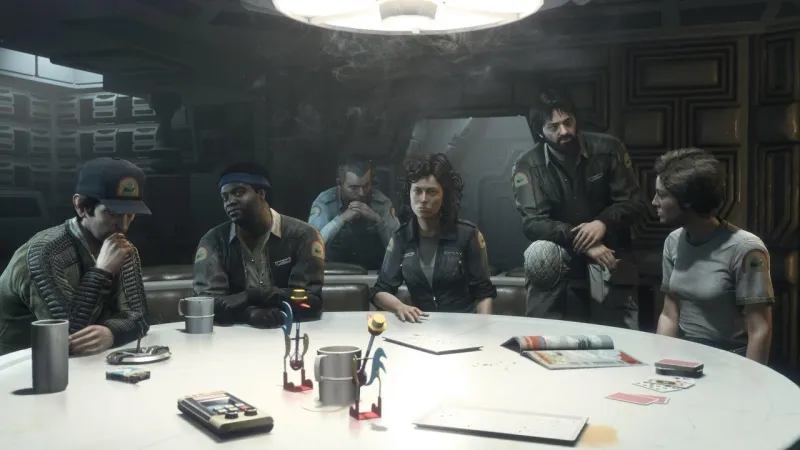
“It was literally like having a library dedicated to Alien,” Hope says. “Those kinds of tiny details were so important to us because we were turning a 116-minute film into an hours-long experience.”
The team made a rule — nothing can go into Isolation that couldn’t be made on Scott’s set. Concept artists used felt tips as an ode to Ron Cobb’s original pen-and-ink designs. But Hope knew the sound of Alien was just as important as the look and continually asked Fox to look for audio materials as well. Eventually, it found an 8-track reel labeled “Alien — M+E.” It was an original recording of the titles and low moaning sounds of the Alien planet; the subtle but impactful drone beneath Goldsmith’s score. For sound designers James Magee and Sam Cooper, that reel was invaluable. “It’s really special to have something like that — to hear the sound engineers working and talking about the effects they were recording and hearing the results as they were happening”, Magee says. During development, the team had the 1979 original playing on TV screens in the office on loop, to the point where every developer must have technically seen the film over 100 times. “The further we progressed, the more lines began to blur between telling if someone had the movie or the game on their monitor,” Magee adds.
Alien: Isolation began life in third-person perspective. “It was the only way we could get it greenlit — it was a different time for survival horror back then,” according to Hope. He was desperate to make the game, and so Hope agreed, secretly believing in the back of his mind he could switch it back to first-person. The game progressed in this state through a considerable length of development, until one day someone went rogue. “Someone came to me and said, ‘There’s a better experience for the game than what we’re building.’ They showed me they’d hacked the camera to Amanda’s head — it was like night and day,” Hope says.
Technical Director Mike Bailey was there too, and was torn seeing the tech test in action: “There was a concern that everything we’d built that worked in third-person may not hold up in first-person because you’re so much closer — but when I saw the game in first-person for the first time, in my head I was just going, ‘Yes. Yes!ʼ I always believed in the game, but having it in first-person just elevated something about it.”
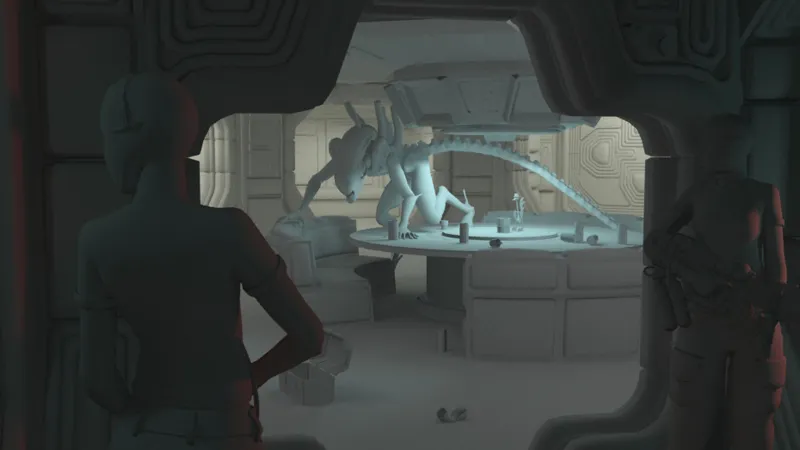
You can’t have an Alien game without a Xenomorph. Upon release, many players claimed the alien almost seemed to be actively learning from its encounters with the player. So, what is under the technical hood of Isolation’s alien? That’s due to having a 100-node behavioral system tree, with whole sub-trees dedicated to tasks like searching or attacking, which gradually unlock as you progress. It’s even able to understand if it recognizes you and knows whether it has seen you before, meaning every first-time encounter with the alien can be different. Technically, the Xenomorph has eyes in the back of its head via a short-range sensor, so you can never sneak behind it. This allows the creature to essentially “play” the game with the player — it’s immensely interactive and nuanced in its decision-making skills, meaning even the developers didn’t always know what it would do. This led to one amusing debugging session in which they rigged the alien to talk, meaning it would exclaim out loud what it planned to do and when.
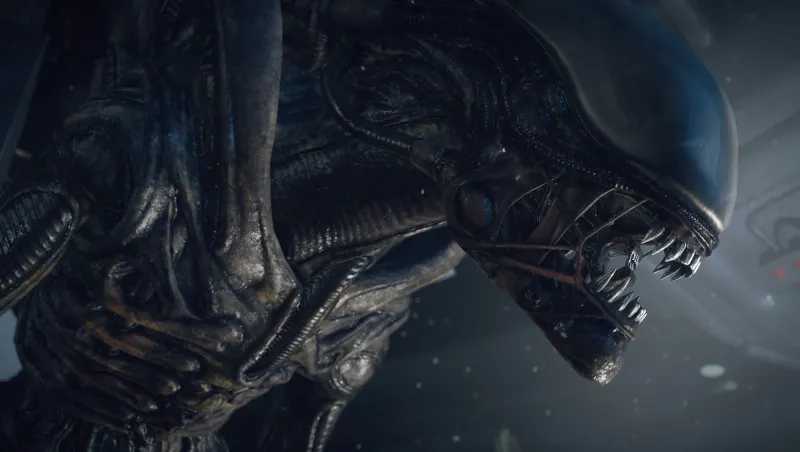
Animator Simon Ridge explained the bodily makeup and movement of the Xenomorph is inspired by myriad beings, from dinosaurs to big cats and even Nosferatu. “The hope was that it would make it feel odder, because of the mixture of monsters and creatures,” Ridge says.
The tail was a particular challenge to animate, at times needing to be almost weightless while at others, as Ridge describes it, “a big chunk of meat being chucked onto the ground.” There’s a deep complexity to how the alien is animated, with over 80 animations just for movement. The unscripted nature of the alien pushed Ridge and his team to find an innovative solution to blending animations on the fly — so many external factors can affect the alien’s decision-making, down to even which speed of walk it chooses. Their solution was to construct a dense “cloud bank” of data so the game could render a blend in real-time rather than rely on pre-visualized animations. “It was a huge group effort to bring the full feeling to life — and an absolute privilege to be part of creating the Xenomorph,” according to Ridge. There are also many kill animations, which also activate depending on how close you are to the alien, and the space around you. The team can’t remember a specific number, but it’s “definitely in double figures,” including an incredibly rare death animation involving a mini locker that only a few lucky players have stumbled across.
The inherent unpredictability of the alien’s AI systems made level designer James Green and his team continually reassess their designs as the Alien came online. Green found the game’s first mission, “Welcome to Sevastopol,” one of the most difficult to design — it had to inform player mechanics and set an atmosphere, emphasize player curiosity as key, introduce them to their big threats, and more.
You may not realize this, but there are barely any dead ends in Alien: Isolation. Every level is built on a strong foundation of loops, as the team recognized it as a key need of the Xenomorph’s AI. Players typically won’t notice these loops because of the clever roadblocks built by Green and his team — the hacking mini-game, having to redirect power, and opening doors for other NPCs, for example. “It was never clear-cut; you’d have to double back on yourself at times,” Green says. “It’s also not an accident that the thing that pushes you toward your objective just happens to make a shitload of noise.” Every level designed by Green and his team serviced the simple mantra of low-frequency, high-impact. You may not always cross paths with the Xenomorph, but when you do, you’re sure to remember it
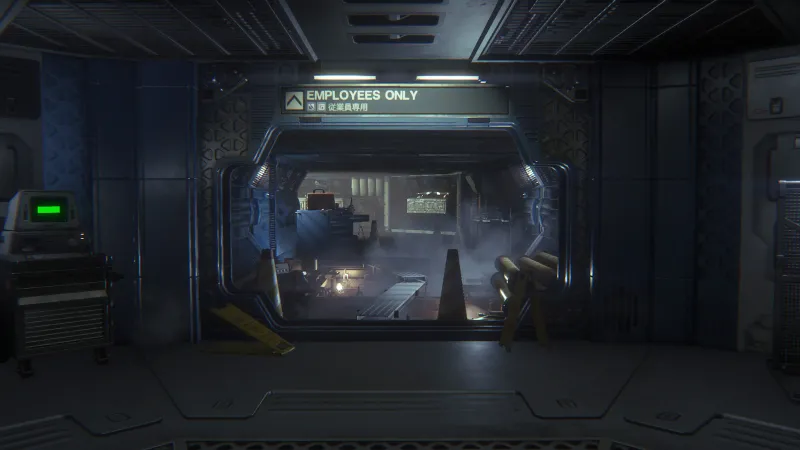
Green also worked on the Working Joe-focused mission, “A Synthetic Solution,” where you delve into the Dexter-inspired Operating Theater complete with plastic wrap covering android corpses. For Hope, the Working Joes evolved from a need to have a “Rock, Paper, Scissors” of conflict — Alien, Human, Android. The androids’ personalities harken back to British public information adverts and older British TV like The Prisoner and Sapphire & Steel. Green mentions the team felt it was important to have a location dedicated to understanding the lore behind the Working Joes’ presence on Sevastopol. Because of “A Synthetic Solution,” Green was assigned to balance the bots out and rework them due to a few kinks in their programming in the last few months of development.
“As soon as there was more than one Working Joe, if one locked you down, the others would form a queue, so as soon as you’d be done with one, the next would just immediately start strangling you,” Green explains. Green thinks of them best as Alien: Isolation’s answer to zombies. “The fun is the delicious tension of just about keeping them at arm’s length.”
Speaking to technical director Mike Bailey, he admits that scaling the game’s technical challenges onto five different platforms across two generations was difficult — especially the PlayStation 3. “As we got close to shipping, it was all I spent my time on,” Bailey says. “I never saw the cool next-gen stuff because I was looking at the game 24/7 on a 720p resolution.” One of Isolation’s most laudable achievements, and biggest challenges for Bailey, was its dynamic lighting. Many games “bake” light into their engine, but Alien: Isolation’s lights flicker, turn on and off, and spin around. They do everything. But all that functionality bears a heavy load on a game whose environments are already dense with resources and material, let alone a game needing to run on two separate generations. Their initial lighting experimentation attempts, including the at-the-time new global illumination concept, failed due to expenses or memory limitations.
So, how did they achieve it? Two overly enthusiastic programmers who loved to bring their work home with them. “They went away one weekend — they always had their own projects going on,” Bailey says. “They came back with this proof of concept — we built a prototype, it looked like it had legs, it ran on a PS3, and so we ran with it all the way to release.”
But Alien: Isolation’s most complex system is not the Xenomorph’s AI, but the sound itself. Sound designers James Magee and Sam Cooper explain they constructed an understandable language around the creature’s vocals, giving the player vital information about what it’s thinking and feeling. “It was a really iterative process that took nearly the end of development to get right”, Magee says. You’ll also rarely hear the same piece of score twice, and that’s thanks to programmer Stuart Sowerby’s work. The game will constantly assess factors like the player’s stealthiness, the alien’s threat, and construct layered mixes on the fly, creating an unpredictability to the music cues that keeps the player off-balance. “We wanted to make sure we had plenty of levers to pull throughout the game,” Sowerby explains.
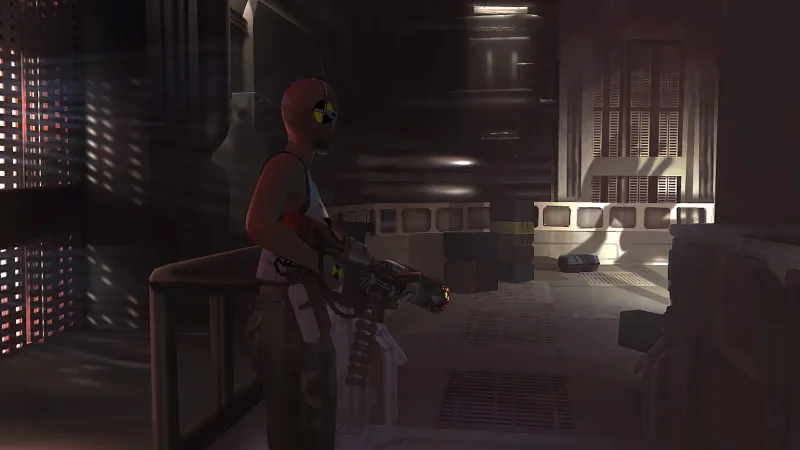
The game also adjusts the audio mix on the fly based on these emergent scenarios, sometimes ratcheting up Amanda’s foley to a hyper-realistic level at the same time as the Xenomorphs’s sounds and movements to put the player increasingly on edge — you can actually hear Amanda’s sneakers squeak if you listen closely. “It’s something they use quite effectively in horror, so being able to do that in a dynamic way was cool,” Sowerby says. Speaking of foley, you can thank a vat of meat, vegetables, nuts, and more for the alien’s sinuous, textured movements. “Moving and manipulating all that content gave us the horrible texture we needed — but the smell lingered in the studio for a while.”
While Christian Henson and musical duo Joe Henson and Alexis Smith of the band The Flight wrote the game’s score, Creative Assembly licensed four of Goldsmith’s original cues and captured them at AIR Studios. Some of Alien’s original orchestral players even returned to re-record for Alien: Isolation. All of this was done in service of the dynamic, interactive sound systems at work: “So much of it is being chopped and mixed to build a particular moment in the game — most of the music is interactive to some extent,” Sowerby says. The game’s foundational interactivity, unpredictable systems enmeshing with one another whilst attempting to build authentic cinematic moments, was one of the sound design team’s biggest challenges. Audio is key to Alien: Isolation — if you don’t listen, you die. Hope champions the sound design team’s efforts as one of the key reasons for the game’s overwhelming success and enduring popularity. “They created this completely immersive soundscape that’s half the experience,” Sowerby says. “Audio really was key to the gameplay of Isolation.”
In its final year of development, Alien: Isolation went through a constant stage of refinement on every level. Every core aspect had to serve the ultimate tight-rope walk of tension players would perform throughout, or it would all fall apart. “That see- saw of emotion was critical to the experience we were crafting,” Hope explains. A small team even decamped to a hotel room for the weekend to “re-edit” the narrative, coating the room’s walls in flip charts and Post-it notes.
After working on all of these systems individually, Creative Assembly felt it had delivered on its vision. But would anyone outside of the company actually care? When they took a preview to 2014’s EGX Rezzed, the team got their answer as gamers flocked to their booth, excitedly chattering amongst themselves after seeing the game. “That was the moment where we finally knew there was going to be an audience for the game,” Hope remembers.
Hope regards this as the most special moment of developing Isolation. Since then, Alien: Isolation has firmly implanted itself in the lore of Alien’s chilling universe — the Working Joes make an appearance in Cold Iron Studios’ shooter Alien: Fireteam Elite, and Alien: Isolation’s save-points can be seen in Fede Álvarez's film, Alien: Romulus. For Hope, the fact that people are still discussing the game today is more than enough for him. “For Isolation to find an audience and people to get so immersed, even people who didn’t know what the Alien IP was, is tremendous,” Hope says. “It’s a testament to the fantastic work of the crew that put it together.”
Like Weyland-Yutani, Creative Assembly cannot get enough of that perfectly evolved predator, announcing on the game’s 10th anniversary that a sequel is officially in development. Details of the game are being kept under wraps tighter than a Facehugger’s tail around a space docker’s neck, but it’s clear that Hope and his team have found an idea that will terrify and titillate a brand-new generation of video gamers the world over. For now, we’ll have to sit and wait anxiously for this alien egg to hatch until Creative Assembly is ready to unleash their new nightmare upon us.