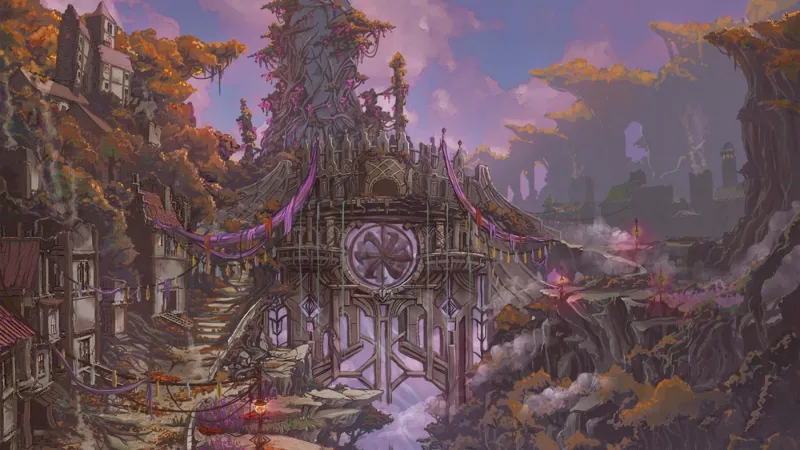
Tales of Arise, Mahag Saar, concept art


A determined swordsman, time-travel, and the threat of world domination; these elements can apply to many games. However, these three assets built one of Japan’s biggest RPG series. The Tales series began with Tales of Phantasia in 1995, and its popularity has grown with each subsequent entry. Tales of Symphonia, Vesperia, Abyss, Xillia, Zestiria, Berseria, and Arise, alongside others, have each added to a legacy that today is one of Bandai Namco’s most consistent and beloved RPG franchises.
Capturing the essence of fantasy is a delicate art. Many elements need to come together for it to work, much less succeed. But with each new entry, Tales has managed to elevate itself and compete with RPG juggernauts like Final Fantasy and Dragon Quest. Also known as Tales of in the West, the Bandai Namco franchise has been going strong for 30 years, a hallmark anniversary for any series. From the original Tales of Phantasia, the smash hit Tales of Symphonia, and the latest Tales of Arise, the anthology has had 19 mainline entries. Many of which, like Tales of Graces f and Tales of Xillia, have been remastered, with more on the way, as part of the momentous milestone.
In celebration of the occasion, I spoke with the series’ figureheads from across its 30-year run. Throughout our conversations, the team bared their hearts and souls, shedding light on the many titles that have been released and those soon to be.
The Tales series is many things, depending on the entry. In Tales of Symphonia, you escort your childhood friend to fulfill her destiny in saving the world. In Tales of Berseria, you are on the revenge quest of a hellbent human Daemon against those who killed her loved ones. The anthology action RPG franchise thrives on telling a new story each time, always keeping things fresh. Still, Yusuke Tomizawa, the series’ current IP director, explains how the focus on characters keeps the series unique.
“First of all, I think the most special thing about Tales of is its character-driven stories,” Tomizawa says. “There are many characters with diverse ideas, but when they become a party and go on an adventure, they have a strong bond through conflict and mutual understanding. I think that’s what makes it different from other IPs. You could say that that’s a very common appeal point for JRPGs, but over the course of 30 years, we took great care to make sure to craft these characters and create these character-driven stories, and we figured that that’s a way we could find ourselves unique from other JRPG titles.”
Many of the series’ leads have different responses about what pillars define a Tales game. From the diverse cast of characters to animated cutscenes, it ranged from one end to the other. Series producer Kenji Anabuki mentions that the team once sat down to discuss it as a group at Bandai Namco.
“We were asked what is important in Tales,” Anabuki says. “The consensus was that, while the battle systems and scenarios are vital, the most important thing is the character expression. Seeing the character from various angles, emotionally, the charm of the characters, the battle scenarios from various angles, and the fact that you can bathe in it. Those are some of the big charms of Tales. I remember that we talked about how we couldn’t leave that out.”
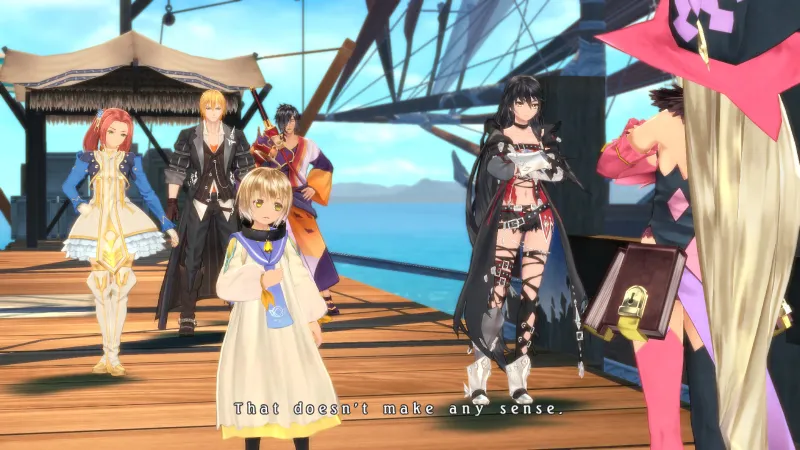
Tomizawa expands on Anabuki’s claim, saying that every factor, old or new, needs to build on top of each other to make the characters and world more appealing. For them, if there isn’t a force multiplier for that, it may not be worth putting into the game. Even still, if an aspect of the game makes the characters more appealing, the team looks to dig deeper into it and expand upon it. For many, it could be the skits or even the anime-inspired cutscenes.
Speaking of skits, the optional conversations between party members have been a staple of the franchise. Often comedic and light, they add depth to the characters and bring some levity to sometimes dramatic storylines, as it did for Tales of Berseria, according to its director (and series producer), Yoshimasa Tanaka. From starting as plain character silhouettes to full 3D cutscenes today, it’s become many players’ favorite part of discovering the worlds and team members. Its inclusion is one that the developers are keenly aware of and want to see involved.
“From a developer’s point of view, skits are convenient,” Tomizawa says. “You can store the story in them and, as Tanaka-san said, you can balance the tone of the work. They are very effective in arranging the work. When I first saw them, I thought they were amazing. I thought I would never lose them. On the other hand, Tales of Arise was when we wanted to bring 2D skits into 3D. I talked to a lot of people about skits. In that work, I wanted to keep the expression and memorability of the skit, but make it more immersive and dramatic. Fortunately, we were able to do it in 3D, though it was quite difficult. I don’t know what’s going to happen in the future, but that’s how skits are, and a lot of people are enjoying it. The fact that there’s still a gap in the market for that, I think it’s something that we’ll have to do for Tales in the future as well.”
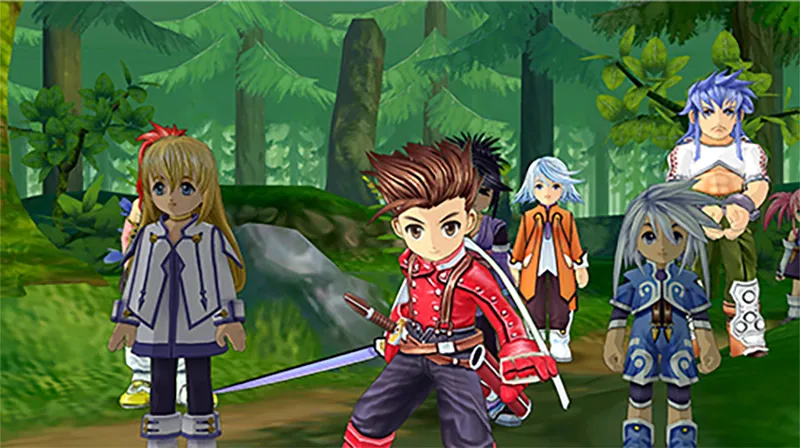
When looking back on the series, one title stands out as a highlight of the conversation: Tales of Symphonia – one of the series’ biggest releases. It launched in 2003 in Japan and 2004 everywhere else as a GameCube exclusive. Following swordsman Lloyd Irving, he and a ragtag band of characters set out to escort his childhood friend to fulfill her destiny in saving their world. For many, the game was their entry into the series’ fantasy worlds, as it hit big in the West and Japan. Yoshito Higuchi, who directed the title alongside other early 2000s Tales entries, knew it was special while they were making it.
“There’s definitely a bunch of different things that we think make [Tales of Symphonia] special,” Higuchi says. “One thing that comes to mind is the story and the setting; it’s definitely not very straightforward. It’s a bit of a curveball, and I think a lot of fans really enjoyed that. It was also the first 3D game in the series, so we were able to do a lot of things, like an evolved version of our normal linear motion battle system (LMBS for short). It’s still 2D-based, but we were able to do different things because now it’s 3D models in the game. The other thing people really liked were the event scenes, as, since it’s a 3D game, we could do a lot more different things with the characters, with the camera work in those scenes. Another thing would be the dungeons. Because of the 3D advancements, we were able to add new features to the dungeons, and because this game came out on the GameCube, we really thought about how we would make this game appealing on a Nintendo console as well.”
Switching from 2D to 3D was a difficult task. The rush was mostly due to the impact of Square Enix’s Final Fantasy VII on PlayStation in 1997. For Higuchi, the switch had already been set in stone for Symphonia.
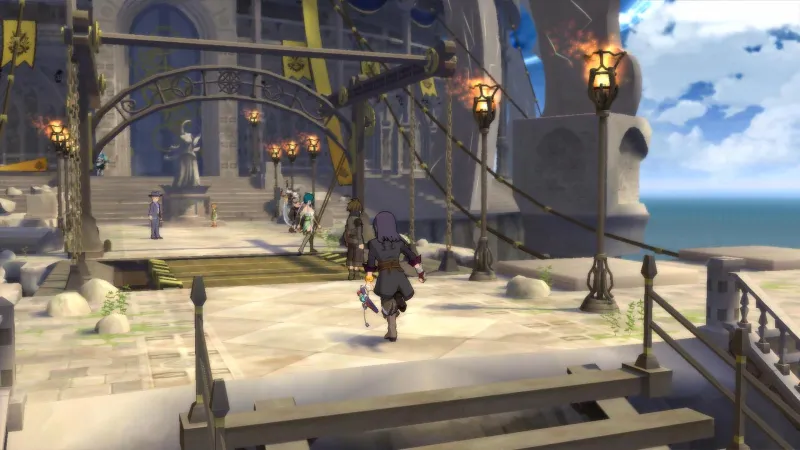
“My first project [Tales of Destiny 2] didn’t have anything to do with 3D,” Higuchi mentions. “When I joined the project, it was already decided that I would do it in 3D. I don’t know what led to that decision, but at the time, there were sort of two lines of development with the Tales of series: one being more for artists Mutsumi Inomata’s designs from Tales of Eternia [Tales of Destiny 2 in the West] and for Kosuke Fujishima’s designs from Tales of Phantasia. I went with Fujishima, which was the 3D title. A lot of Symphonia’s team were very new, a lot of fresh faces, people new to game design, and on top of that, it was the first time that a lot of people were using 3D tools, so it was like a lot of figuring out as we were going along, and it was a very big learning experience. However, because of the things that we learned during the development of Symphonia, it led to titles like Tales of the Abyss and Tales of Vesperia. The team also got along well with each other, which helped a lot.”
As far as development stories go, Higuchi recounts some troubling memories, as the team was spread across three different titles (Tales of Destiny 2, Symphonia, and Rebirth).
“This is definitely something that wouldn’t fly today,” Higuchi says, “but we all were running on a really, really tight schedule, so the memories from back then would be sort of like sleeping in the office, eating three meals together, [and] because we couldn’t shower, we had to go to the local bathhouses.”
From there, the series grew in popularity, which meant more eyes were on the franchise than ever before. Fortunately for the team, subsequent projects like Tales of the Abyss and Vesperia both hit with fans and newcomers. In fact, many of those whom I spoke to said many of their favorite moments and characters come from those two titles, like Tales of Vesperia’s Karol Cappel for Anabuki and Tales of the Abyss’ Luke fon Fabre for Tanaka.
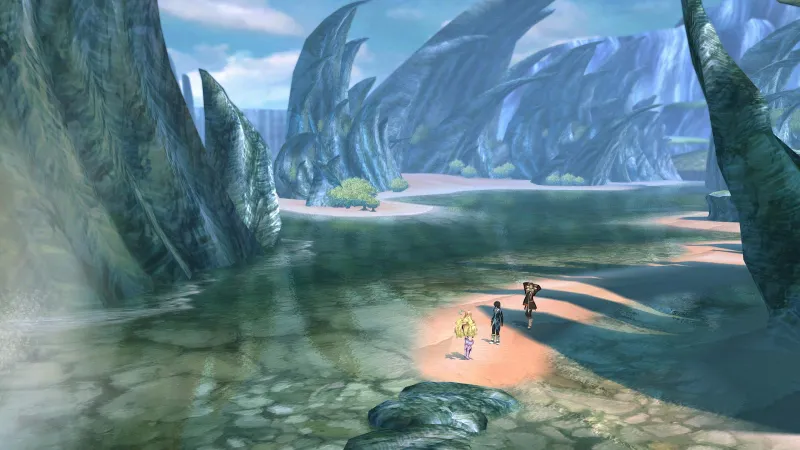
One of the interesting things about Tales is how each game looks relatively different from the other in terms of design. Masahiko Musha, who has worked on the series since Tales of Symphonia as an art designer, talks about the various titles and bringing the art from the pages to life in 3D and beyond.
“As the series evolved, we wanted to experiment with different things,” Musha says. “For Symphonia, it was to take the 2D sprites and directly translate them into 3D models. As you can probably tell, the 3D models are sort of like cute sprites. We wanted to make sure that you could see what the 3D models were doing from far away. After that, for Tales of the Abyss, we thought about slimming down the characters so that they not only look better, but they can do more on camera. Plus, Production IG’s animated opening helped develop the style of the game. Then, for Tales of Vesperia, we incorporated a more cel-shaded style. After that, for Xillia, we wanted to truly bring the character designs and the character models together, as there was sometimes a disconnect between them.”
Even so, Musha did enjoy the ease the older generations had with art style.
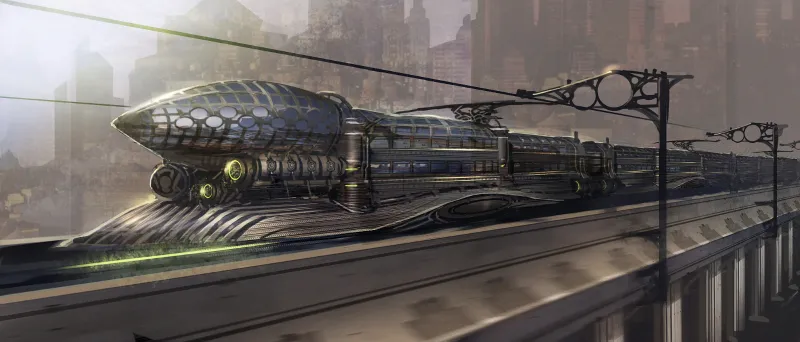
“I feel like I was able to make a lot more with the old engine,” Musha says. “For older titles, there was a lot of the designs that you could sort of shortcut, so we were able to make a lot more designs and put them in the game. So, for quantity, the old games were a lot better. But now, because we want to make more rich and detailed art, the more modern games, we don’t have to sort of make those sacrifices. So it’s a lot easier for us to sort of translate our designs into the game.”
He also remembers how difficult some of the models were to do as the technology progressed. One such trouble was Tales of Xillia’s Milla Maxwell. “Making Milla’s hair was really tough,” snickers Musha. “However, she’s a very important character in Xillia, and it was very important that we got the hair right. So it was fun making it, but it was very difficult.”
Tales of Xillia was released in 2011 to celebrate the franchise’s 15th anniversary. The title, which recently got a remaster in 2025, did incredibly well both in Japan and stateside. Much of the praise went to the game’s visuals, battle system, and story. When talking to the team, it was agreed that the diplomatic butler Rowen was one of the series’ best characters, a view many fans, myself included, echo. That next year, in 2012, a sequel, Tales of Xillia 2, launched, expanding the world and characters of the original. The director of the game, Anabuki, spoke about the chance to explore more of Tales of Xillia’s world.
“It’s true that it’s a lot of work to build a world, but we also put a lot of effort into building the world of Xillia, so we thought that we could use this world to create a different approach to the game,” Anabuki says. “Xillia 2 is a very different game design, but we thought that we could use the world of Xillia to create a new game. In Xillia, there was Rieze Maxia and Elympios, but we didn’t get to touch on Elympios much. So, in Xillia 2, we were able to expand the world of Xillia. I think that’s why we were able to develop Xillia 2.
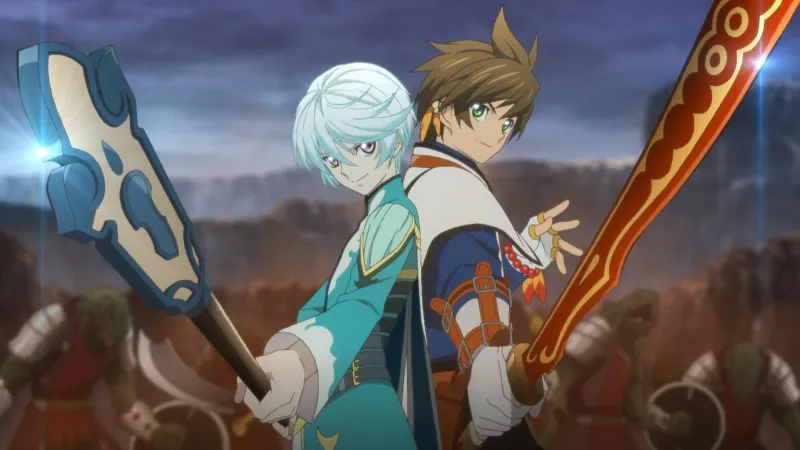
Following suit was Tales of Zestiria in 2015, which, while generally well-done, landed softly for critics and fans. Fortunately, a prequel in the form of Tales of Berseria came out the following year, which marked many new changes to the series formula. Most notably, it deviated from male main characters to have a sole female protagonist in Velvet Crowe.
“At the start, we actually thought about making Berseria with a male main character, but with the story we had in mind, the final destination of this character, of where he reached at the end of the story, it wasn’t really coming together well, so what if we did it with a female main character, and then it made a lot more sense to us, so that’s the path that we took with this game,” director Tanaka says.
As for other changes, one notable one was the evolution of the linear motion battle system. The system, which has players move back and forth along a straight line toward an opponent for combat and maneuverability, distinguished itself from other franchises at the time. With each entry, the combat grew more and more traditional, eventually arriving at more action RPG gameplay in Tales of Arise.
“In Tales of the Abyss, we had a free run for the first time, but we added elements that were a bit different from the LMB system,” Tanaka says. “Based on that, we had a more open free run in Berseria. I think that was necessary for the evolution process. We wanted to have a wide range of players play it, but having the camera operate during the action made it a lot more difficult.”
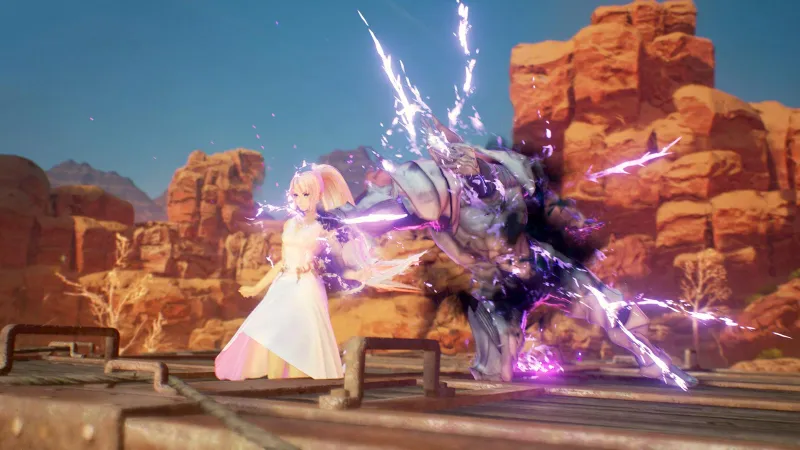
For many, including me, the latest mainline title was their introduction to the series: Tales of Arise. Released in 2021, the story of Alphen, Shionne, and crew fighting for peace against oppression, alongside its vast, colorful open world, charmed millions. Becoming the best-selling franchise title, it got numerous accolades, including Best RPG at The Game Awards. All those I chatted with worked on it, either the base game and/or its expansion, Beyond the Dawn. From Tomizawa’s perspective, its success was bolstered by the simultaneous worldwide release, which had seldom been done before in the series.
“We were able to share our expectations with everyone across the world as we waited for the release,” he says. “It was something that we couldn’t do with Tales of until now. I think that was a big achievement for us as producers.”
Interestingly enough, the Tales of Arise version fans got wasn’t the initial one the team started with. Tomizawa mentions that one of the keys to Tales of Arise was balance, and early prototypes didn’t capture the essence of the franchise. A ton of rebalancing happened to fine-tune it. Still, Tanaka, who joined the project during the second half of development after visuals, was skeptical of it.
“At first glance, [Tales of Arise] looked like it had come to a different dimension from Tales, but when you actually played it, there were some easy-to-understand specifications like skits,” Tanaka says. “It also had an essence that you could feel from every nook and cranny. The same goes for the character’s voice, and from the skits and back-quests, you could really feel the Tales-ness.”
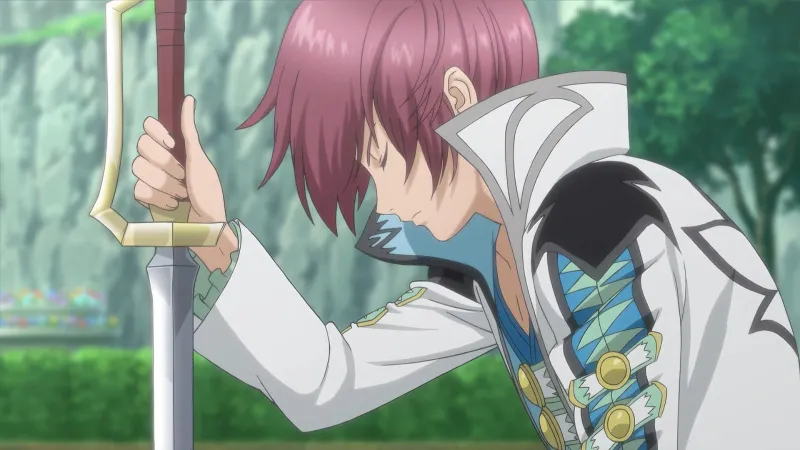
In 2026, the team will continue the Remaster project, which began in 2025. Two titles came from it, Tales of Graces f Remastered and Tales of Xillia Remastered. In February, Tales of Berseria Remastered will launch. While not confirming much, Tomizawa does tease what is next for the project, stating, “We like to do the titles that fans have been looking forward to, so stay tuned for news on that.”
Given the direction of remasters, the question arose of whether remakes of older titles, perhaps ones that never came to the West, would be made. While Tomizawa says they aren’t entirely out of the realm of possibility, it would take a lot of handiwork to do it, especially in the modern era.
“Remakes also often need a lot of resources, almost as much as making a new game, sometimes even more,” Tomizawa says. “It’s not an easy project. Even if we do one, it’ll need to have as much potential as a new game. There have been lots of discussions internally about potential ones, but we understand that fans want old games, especially ones where people fondly remember them, so it’s a possibility. Timing does need to work out for them.”
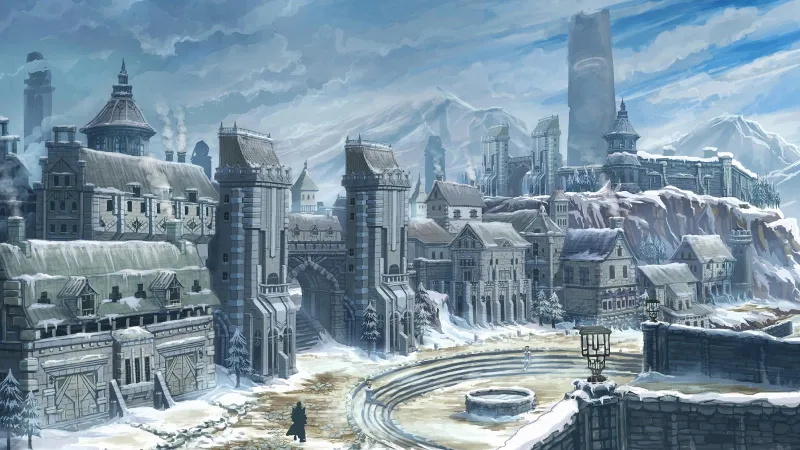
Even with the many Tales games now available, fans are eagerly anticipating the next new entry in the franchise. The wait for a new title has been long, as Tales of Arise launched in 2021. Tomizawa hears the players loud and clear on that front but is keen to make sure the next title meets expectations.
“We understand that what’s more important for fans is a completely new game,” he says. “Rest assured that our amazing development staff and team are working hard on what’s next for the series.”
Bandai Namco’s JRPG franchise is one made of heart and grit. When you enter one of its worlds, you know you’re in for a treat. Like an ice cream shop, there are plenty of different flavors to choose from. Whether you like it dark and mysterious or light and cheerful, Tales has you covered. The future of the franchise is bright, and I, for one, am excited to see more of what the team has to offer.